.svg)
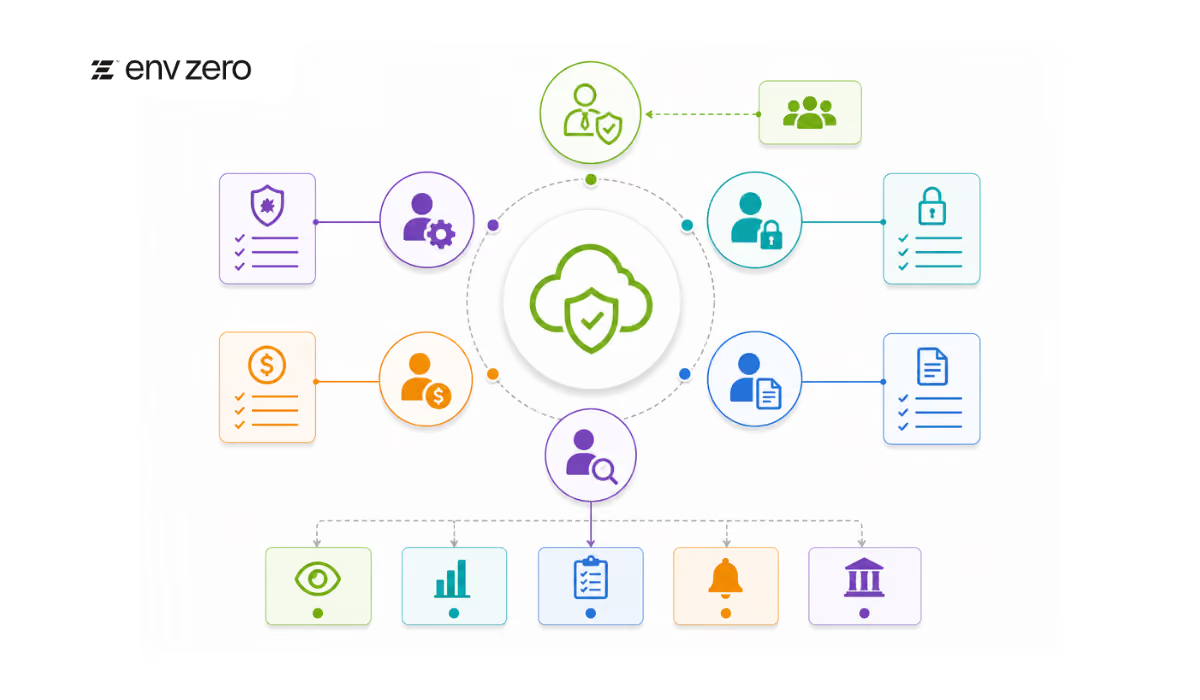

A cloud accountability model defines who owns which cloud resources, who has authority to make which decisions, and who is responsible when something breaks — across platform, security, finance, and operations teams. For the plain-language case for why this matters, see Cloud Accountability Across Teams.
What a Cloud Accountability Model Should Include
Accountability breaks down into a specific list of ownership questions:
- Resource ownership
- Decision-making authority
- Review and approval responsibilities
- Escalation paths
- Shared service ownership
- Financial accountability
- Security accountability
- Compliance accountability
- Reporting and audit requirements
Without these controls, organizations may have governance policies but lack the ownership structure needed to support them.
The Core Components of a Cloud Accountability Model
Define Resource Ownership
Every cloud resource needs an accountable owner, not just a creator.
Ownership should identify:
- Who maintains it day to day
- Who reviews and approves changes to it
- Who responds when something goes wrong with it
- Which ownership layer it falls under — infrastructure, application, security, finance, or compliance
Without a named owner across those questions, cloud resources often remain active without support, review, or a clear point of accountability when something breaks.
Separate Ownership by Layer
Cloud accountability should separate responsibility across different layers of the environment.
Examples include:
- Platform teams owning core infrastructure
- Application teams owning workloads and deployments
- Security teams owning access policies and monitoring
- Finance teams owning budget tracking and forecasting
- Compliance teams owning audit readiness and regulatory controls
Layered ownership reduces confusion and helps teams focus on their specific responsibilities.
Define Decision-Making Authority
Organizations should clearly define who can make different types of decisions.
This may include:
- Who approves production changes
- Who approves high-cost resources
- Who can create policy exceptions
- Who can modify access controls
- Who can approve new cloud accounts or environments
Decision-making authority helps reduce delays and avoid unnecessary escalation.
Create Clear Escalation Paths
Some issues require escalation beyond the owning team.
Organizations should define escalation paths for:
- Major production incidents
- Compliance violations
- High-cost spending increases
- Security breaches
- Policy exceptions
- Shared environment conflicts
Clear escalation paths help ensure that major issues receive the right level of attention.
Assign Accountability for Shared Services
Shared services often create confusion because multiple teams depend on them.
Organizations should define ownership for:
- Networking infrastructure
- Logging platforms
- Monitoring tools
- Shared databases
- Identity and access systems
- Security services
Shared services should have a clearly assigned owner even when multiple teams use them.
Build Financial Accountability
Cloud accountability should include ownership for cloud spend.
Organizations should define:
- Which team owns cloud budgets
- Who reviews cost reports
- Who approves high-cost resources
- Who is responsible for optimization
- Who responds to budget overruns
Financial accountability helps organizations manage cloud spending more effectively.
Define Security Accountability
Security responsibilities should be clearly assigned.
Organizations should define:
- Who manages access controls
- Who reviews vulnerabilities
- Who responds to security alerts
- Who approves security exceptions
- Who manages encryption and network policies
Without security accountability, critical issues may remain unresolved.
Define Compliance Accountability
Organizations operating in regulated industries should assign ownership for compliance activities.
This may include:
- Audit preparation
- Policy reviews
- Evidence collection
- Data retention controls
- Regulatory reporting
- Exception documentation
Compliance accountability helps organizations maintain stronger governance and audit readiness.
Build Accountability Into Daily Workflows
Accountability should not exist only in documentation.
Organizations should integrate ownership into:
- Infrastructure provisioning
- Change management
- Approval workflows
- Cost reporting
- Incident response
- Security monitoring
When accountability is built into workflows, teams are more likely to follow governance requirements consistently.
Review Accountability Regularly
Cloud environments change over time.
Organizations should review:
- Ownership gaps
- Shared services without assigned teams
- Repeated escalations
- Delayed remediation timelines
- Budget issues without clear accountability
- Policy violations without owners
Regular reviews help organizations keep accountability aligned with changing business needs.
Common Cloud Accountability Challenges
Unclear ownership across shared environments is the most common breakdown point.
Another common challenge is assigning too many responsibilities to one team.
Platform teams, for example, may become overloaded if they are expected to manage infrastructure, cost reviews, compliance, security, and application support.
Organizations also often fail to define who is responsible for exceptions, unresolved issues, or policy violations.
In some cases, teams assume someone else is responsible for a problem, creating delays and confusion.
Finally, many organizations document accountability once and never update it, even as environments and teams change.
Best Practices for Improving Cloud Accountability
Accountability tends to hold up in practice when a few specific habits are in place.
Keep Ownership Visible
Teams should be able to quickly identify who owns a resource, environment, application, or service.
Separate Responsibilities Clearly
Platform, security, finance, compliance, and application teams should each have clearly defined roles.
Align Accountability to Risk
High-risk environments, production systems, and regulated workloads should have stronger ownership controls.
Use Automation Where Possible
Automation can improve ownership tracking, tagging enforcement, approval routing, and escalation workflows.
Review Ownership Regularly
Regular reviews help organizations identify gaps and keep accountability aligned with changing environments.
How This Looks in Practice: Salt Security
Salt Security used role-based access control to give each team clearly scoped ownership over its own environments — developers could provision and manage what they owned without waiting on a central team, while access boundaries kept that ownership from overlapping with other teams' infrastructure.
That clear ownership boundary is also what made a cost-saving practice like scheduled weekend shutdowns of non-production environments possible: because each environment had a defined owning team, the platform could safely apply lifecycle policies without needing case-by-case sign-off on infrastructure nobody was quite sure who owned.
Conclusion
A cloud accountability model helps organizations define who is responsible for cloud resources, decisions, and governance activities.
It creates stronger visibility, better decision-making, and more consistent operational control across cloud environments.
For organizations focused on cloud governance and risk management, accountability is essential for reducing confusion, improving cost control, strengthening security, and maintaining compliance.
The goal is not to create more processes. The goal is to ensure that every critical decision, resource, and workflow has a clearly defined owner.
The layered structure this model depends on is covered in full in Ownership Layer Model. For how accountability fits into the broader governance model, see Cloud Governance Framework.
FAQs
What is a cloud accountability model?
A cloud accountability model is a framework that defines who owns cloud resources, who makes decisions, and who is responsible for governance activities.
Why is cloud accountability important?
Cloud accountability is important because it improves ownership, reduces confusion, strengthens governance, and helps organizations respond to issues more effectively.
What should a cloud accountability model include?
A cloud accountability model should include resource ownership, decision-making authority, escalation paths, financial accountability, security accountability, and compliance ownership.
How can organizations improve cloud accountability?
Organizations can improve cloud accountability by assigning clear ownership, separating responsibilities, integrating accountability into workflows, and reviewing ownership regularly.
Related Content

Pulumi vs Terraform vs OpenTofu: A Decision Framework Based on Team Type, Scale, and License Risk


Terragrunt Directory Structure Framework: DRY Configs Across Dev, Staging, and Prod
Self-Service IaC Platform Framework: Guardrails, Templates, and Approval Workflows
Terraform Policy-as-Code Framework: Structuring OPA and Sentinel Rules Across Teams
Terraform-to-OpenTofu Migration Framework: A Risk-Tiered Approach for Production Environments







Enterprise Release Control Model: Structuring Secure and Scalable Deployment Workflows
Policy Checkpoint Framework: Enforcing Consistent and Scalable Governance Across Deployments

Audit Trail Governance Framework: Ensuring Transparency, Compliance, and Accountability Across Infrastructure
Release Governance Framework: Structuring Controlled and Compliant Infrastructure Releases

Environment Drift Detection Model: Maintaining Consistency Across Infrastructure Environments
Pipeline Visibility Framework: Structuring Transparent and Controlled Deployment Workflows