.svg)

As deployment processes become more automated and complex, maintaining control across the lifecycle becomes essential — a structured governance framework is what ensures every stage of deployment gets validated, monitored, and aligned with organizational standards, rather than drifting apart as automation scales.
Introduction
Modern infrastructure delivery relies on automated deployment pipelines that span multiple stages, from code integration to production release, and as these workflows scale, maintaining consistency, security, and compliance across each stage gets harder, not easier. Without structured governance, deployments become fragmented and inconsistent, and teams struggle to enforce standards, track changes, or confirm that processes were actually followed.
A Deployment Lifecycle Governance Framework addresses this directly: it's a structured approach to managing and controlling every stage of the deployment lifecycle, applying validation, approvals, policy enforcement, and monitoring consistently enough that teams can scale operations without losing control over them.
What Is a Deployment Lifecycle Governance Framework
A Deployment Lifecycle Governance Framework is a structured model defining how governance gets applied across every stage of the deployment process, outlining the rules, controls, and processes that keep deployments reliable and consistent. Rather than treating governance as a separate process bolted on afterward, the framework integrates it directly into automated workflows, so planning, validation, execution, and monitoring all stay aligned with organizational requirements as a matter of course, not a matter of remembering to check.
Why Governance Across the Lifecycle Matters
In enterprise environments, deployments involve multiple teams, tools, and environments, and each stage of the lifecycle introduces its own risk, from misconfigurations during provisioning to failures during execution to configuration drift creeping in after the fact (see Environment Drift Impacts Deployment Quality for how much that specific risk compounds over time). Without governance, these risks accumulate into unreliable deployments and mounting operational complexity, and teams lose the visibility they'd need to identify issues or enforce standards in the first place.
A structured governance framework keeps every stage of the lifecycle controlled and monitored instead, which is what actually delivers consistency, lower risk, and more reliable deployments at scale. For a closer look at what enterprise teams specifically need from deployment automation to get there, see What Enterprise Teams Need From Deployment Automation.
Core Stages of the Deployment Lifecycle
The deployment lifecycle consists of six stages, each requiring its own layer of governance:
- Planning — defining infrastructure requirements, configurations, and policies, with governance ensuring standards are established before deployment even begins.
- Validation — testing configurations, verifying infrastructure definitions, and confirming compliance with policy, catching issues before they progress further down the pipeline.
- Approval — reviewing critical changes before execution, enforcing accountability and reducing risk at the point where it matters most.
- Execution — provisioning infrastructure and deploying changes under governance that keeps the process consistent every time. See Release Controls for Infrastructure Teams for how that consistency gets enforced specifically at release time.
- Monitoring — tracking system performance and surfacing issues after deployment, so governance extends past the moment code ships.
- Feedback — turning deployment outcomes into insight, so teams can refine both process and governance practice going forward.
Core Components of a Deployment Lifecycle Governance Framework
Effectively governing the deployment lifecycle comes down to six components working together:
- Policy enforcement — deployments checked against security, compliance, and operational standards, typically implemented as Policy-as-Code so enforcement scales with automation instead of manual review.
- Validation mechanisms — configurations and infrastructure definitions tested before deployment, catching errors while they're still cheap to fix.
- Approval workflows — a structured process for reviewing changes before execution. See Approval Pipelines in Infrastructure Delivery for how that review process gets automated without becoming a bottleneck.
- Monitoring and observability — real-time tracking of system performance and issue detection, extending governance past the point of deployment. Pipeline Visibility for Platform Teams covers what that visibility actually needs to include.
- Audit trails — a record of every action in the lifecycle, supporting compliance and making troubleshooting faster instead of forensic. See Why Audit Trails Matter in Deployment Automation for the full case.
- Rollback mechanisms — the ability to revert to a stable state when something goes wrong, minimizing downtime and improving resilience. Rollback Control Framework covers the governance model behind this; Rollback Automation for Enterprise Infrastructure covers the CI/CD-level mechanics that execute it.
How the Framework Works in Practice
In practice, a Deployment Lifecycle Governance Framework integrates governance controls directly into automated workflows: when a deployment is initiated, it moves through each stage with governance applied at every step, not just at the end. A deployment might begin with validation checks against defined standards, move to approval workflows where stakeholders review and sign off, enforce policy compliance during execution, and hand off to monitoring systems that track performance and catch issues once it's live. That structure is what lets governance apply consistently without slowing the workflow down.
Organizations that want to fully automate the full deployment lifecycle with guardrails can integrate governance, validation, and policy enforcement into every stage this way, for controlled and scalable infrastructure delivery. For the deeper mechanics of what that end-to-end automation actually involves, see Full Deployment Lifecycle Automation Explained.
Benefits of Lifecycle Governance
A structured governance framework pays off across several dimensions:
- Consistency — every deployment follows the same process, instead of each team improvising its own.
- Security and compliance — policies enforced at every stage, not just at the end.
- Cost control — incorporating cost governance and FinOps enablement keeps infrastructure decisions aligned with budget constraints, so teams catch unnecessary cloud spend instead of discovering it on the invoice.
- Lower operational risk — issues get identified and addressed early in the lifecycle, before they turn into failures.
- Efficiency — automating validation, approvals, and monitoring frees teams to focus on delivering value instead of managing process.
- Scalability — the most consequential benefit: organizations can manage increasingly complex infrastructure environments without losing control over them.
Common Challenges Without Lifecycle Governance
Without governance, deployment processes become inconsistent and hard to manage: teams skip validation steps or bypass approvals, which leads directly to errors and vulnerabilities, and that lack of structure increases risk while cutting visibility into workflows at the same time. That combination is often exactly how pipelines start breaking down as they scale — see Why Deployment Pipelines Break at Scale for the specific failure patterns. Left unaddressed, it also makes issues harder to identify and resolve, stretching out recovery times, and over time erodes confidence in deployment systems and caps how far infrastructure can actually scale.
How env zero Supports Deployment Lifecycle Governance
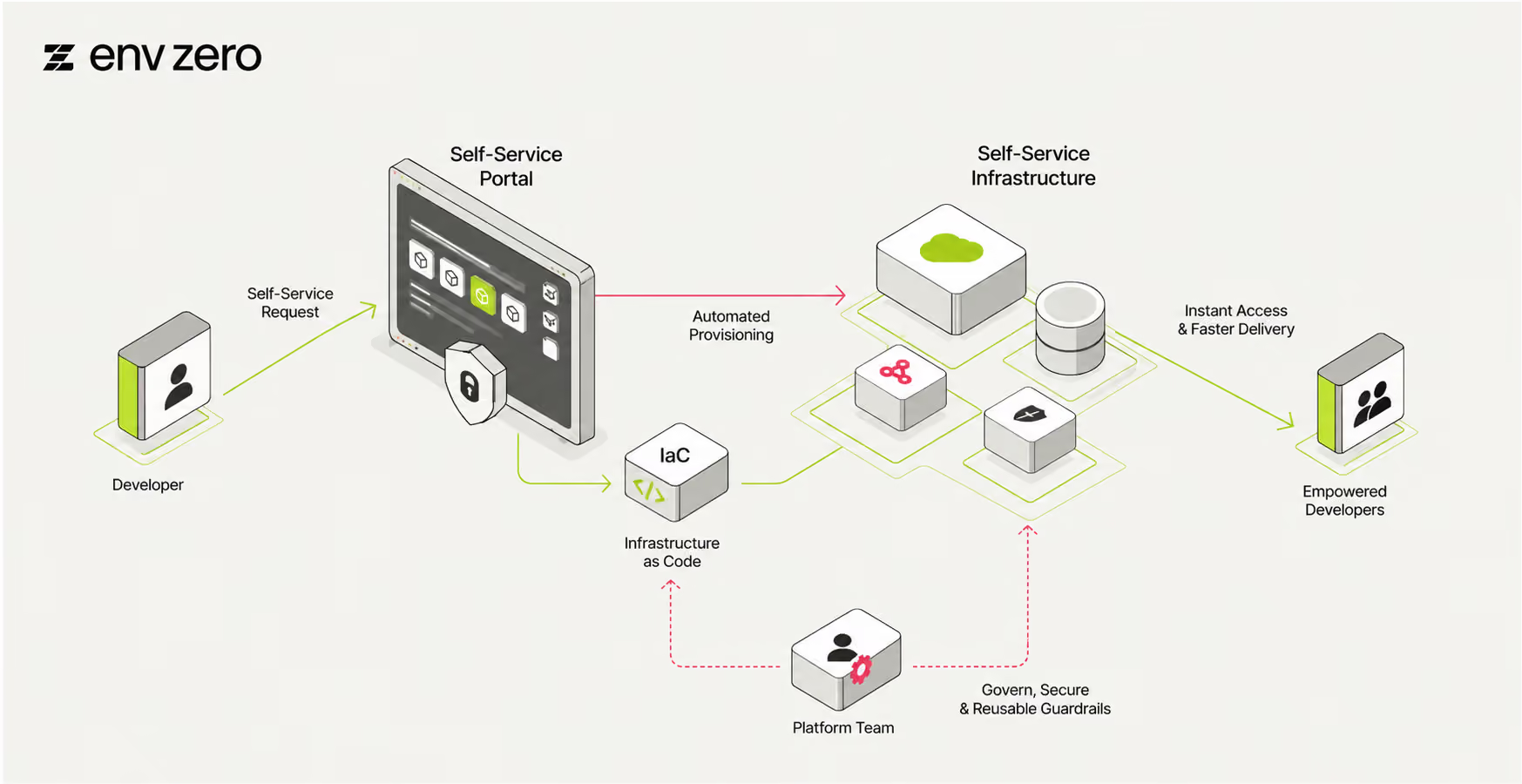
env zero enables organizations to implement a Deployment Lifecycle Governance Framework by integrating policies, approvals, and automation directly into deployment workflows, letting teams define governance rules, enforce validation steps, and manage approval workflows all within one unified platform rather than stitching several tools together. That keeps every stage of the lifecycle controlled and monitored, not just the stages someone remembered to instrument.
env zero also provides real-time visibility into deployment processes so teams can track progress and catch issues quickly, and it supports audit trails, policy enforcement, and rollback mechanisms to keep deployments consistent and reliable. By centralizing governance this way, env zero helps teams maintain control while scaling infrastructure operations rather than having control erode as scale increases.
Best Practices for Implementing Lifecycle Governance
Integrate governance into automated workflows from the start, embedding validation, approvals, and policy enforcement directly into the pipeline rather than layering them on afterward. Using Infrastructure as Code standardizes configurations and cuts down on manual intervention, while continuous monitoring keeps systems stable well after deployment finishes. Beyond the tooling, define clear roles and responsibilities so accountability holds across the lifecycle, and review governance processes regularly, since what worked at last year's scale rarely holds up unchanged at this year's.
Conclusion
A Deployment Lifecycle Governance Framework is essential for managing modern infrastructure deployments, giving every stage of the lifecycle the structure it needs to stay controlled, consistent, and aligned with organizational standards. Embedding that governance into automated workflows, rather than bolting it on after the fact, is what lets organizations reduce risk, improve reliability, and scale operations effectively — and with tools like env zero, lifecycle governance becomes seamless, automated, and scalable rather than another manual process to maintain.
Looking to bring structure and control to your deployment lifecycle? env zero helps you enforce governance, automate validation, and maintain consistency across every stage of your workflows, so you can build scalable, reliable, fully governed deployment processes with confidence.
FAQs
What is a deployment lifecycle governance framework? A deployment lifecycle governance framework defines how governance is applied across all stages of the deployment process. It ensures that validation, approvals, and monitoring are consistently enforced.
Why is governance important across the deployment lifecycle? Governance ensures that each stage of the lifecycle follows defined standards, reducing risk and improving reliability across deployments.
What stages are included in the deployment lifecycle? The lifecycle includes planning, validation, approval, execution, monitoring, and feedback, each requiring governance to maintain control.
How does governance improve deployment reliability? Governance ensures that changes are validated, approved, and monitored, reducing errors and improving consistency across environments.
How does env zero support lifecycle governance? env zero integrates policy enforcement, approvals, monitoring, and automation into deployment workflows, ensuring consistent governance.






.avif)